


I wrote a quick note about a small decision about “Company Structuring” when we plan Q2 strategic meeting.

and, Inga Simonenko asked a question.
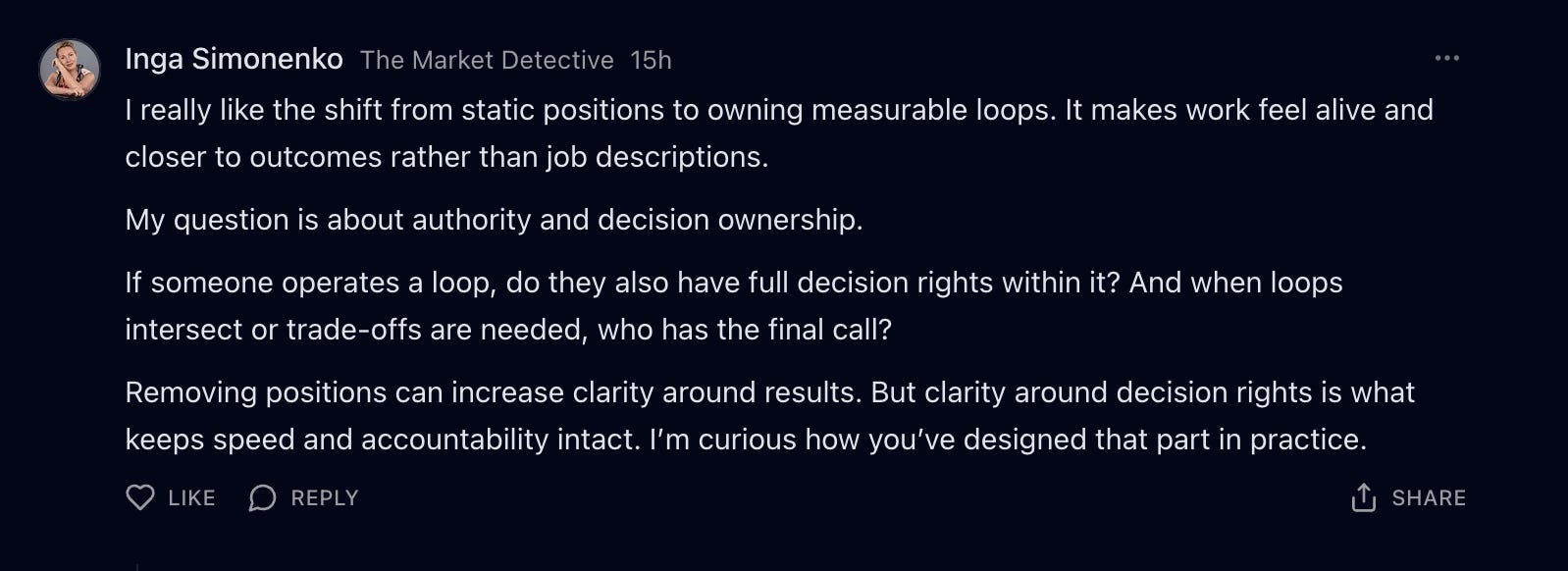
Here is my personal answer, and will apply to our team from Q2.
1) Be honest: humans and AI agents are not different
I wrote this point here

In modern work, “capability” is becoming a utility.
So let’s be honest, humans and AI agents aren’t fundamentally different inside a company. They’re both nodes that produce outputs.
If I define my human colleagues by skills, I and my human colleagues lose. Because skills are being unbundled, summoned, multiplied, and chained.
So what’s the difference?
One difference survives:
Responsibility.
An agent can output. A human can be held accountable for an irreversible action—money collected, risk accepted, a promise made, a shipment sent, a contract signed.
In other words:
Agents produce capabilities
Humans carry liability
This one distinction is why decision rights still matter. Because decision rights are how you assign liability.
2) Humans are the physical world’s OpenClaw
Here’s the deeper framing that resolves the reader’s question:
Humans are the physical world’s OpenClaw, before Optimus replace us.
So the first principle becomes: If someone is accountable for a commercializable closed loop, they must be able to operate it with meaningful freedom—within explicit constraints.
Not “freedom” as a cultural slogan.
Freedom as an operating requirement.
Because loops are not documents.
Loops are living systems.
And living systems need local decision-making to adapt.
If every decision has to climb a chain of command, you didn’t delete “positions.”
You just hid them.
3) The rule: the Operator owns default decision rights inside the loop
My answer to “Do operators have full decision rights?” is:
They have default decision rights inside the loop.
Default means:
they decide unless a written boundary is crossed
they move fast without asking permission every time
they are not “coordinating” the loop, they are owning it
But “full decision rights” is sloppy language.
It sounds empowering, then becomes chaos.
So I make it precise:
A Loop Operator can decide anything that stays inside these boundaries
North Metric boundary
If a decision improves the loop’s north metric without damaging a higher-level company metric, it’s inside.Irreversible action boundary
If the decision helps push the next irreversible action forward, it’s inside.Budget boundary
If cost stays under a pre-approved weekly/monthly budget, it’s inside.Risk boundary
If it does not cross a defined risk threshold (legal, brand, security, safety), it’s inside.Interface boundary
If it doesn’t break another loop’s defined input/output contract, it’s inside.
That’s the shape of authority in a loop-based org:
Local autonomy, globally constrained.
This is how you keep speed and alignment.
Hope I make myself clear.
B.