Everyone is talking about Anthropic’s IPO and ChatGPT’s move into advertising. But I see something completely different:
The cheapest traffic opportunity for CPG brands will not be online at all. It’s right where their products are consumed, in the real world.

Think about that for a moment.
You spend money on Meta, Google, Amazon, influencers, and retail promotions to get your product into someone’s life. You celebrate the sale. You measure your acquisition cost. You update your revenue forecast.
Then something strange happens.
You largely disappear from the customer’s life.
The customer takes your product home, puts it in the refrigerator, on the bathroom counter, in the pantry, or beside the coffee machine.
They use it. They enjoy it. They come back to it.
Sometimes every single day.
And while they are repeatedly interacting with the environment in which your product lives, you are back online paying for another opportunity to get their attention. YOUR PRODUCT ALREADY ENTER THEIR LIFT, Yet you keep paying to reenter their attention. THIS IS INSANE. This is one of the strangest inefficiencies in the consumer packaged goods industry.
And it reveals an enormous opportunity hiding in plain sight.
The Consumption-Space Traffic Nobody Thought to Count

Lets talk about Consumption-Space Traffic. It does not originate from an advertisement, a search engine, or a social media feed.
It originates from everyday life.
Think about your refrigerator.
How many times do you or your family members walk past it, open it, or stand in front of it? 10+ times/day ?
Think about your coffee machine. Your kitchen counter. Your bathroom mirror. Your laundry area.
These places receive recurring human traffic because people have ordinary things to do.
Nobody needs to run an advertising campaign to convince you to visit your refrigerator.
You are going there anyway.
And this isn’t limited to homes.
A mechanic repeatedly visits the workspace where automotive products are stored and used.
These spaces already attract people through the natural process of using, maintaining, preparing, or consuming products.
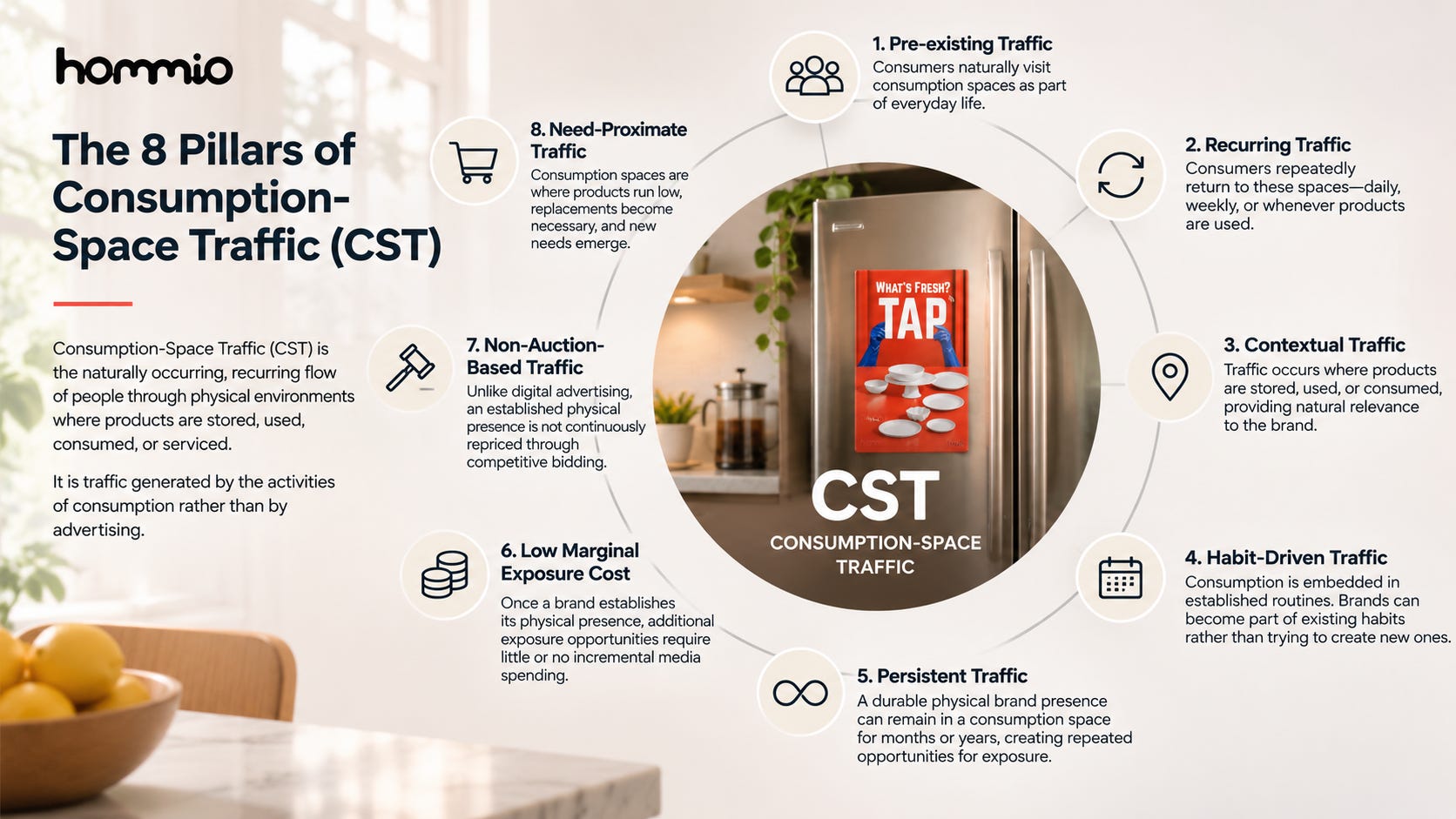
I call this Consumption-Space Traffic, or CST.
Consumption-Space Traffic is the naturally occurring, recurring flow of people through physical environments where products are stored, used, consumed, or serviced.
It is traffic generated by the activities of consumption rather than by advertising.
That distinction changes how you should think about customer retention.
Because while most traffic must be continuously acquired, much of this traffic already exists.
You do not need to create the behavior.
You need to find an appropriate way for your brand to become useful within it.
The 8 Pillars of Consumption-Space Traffic
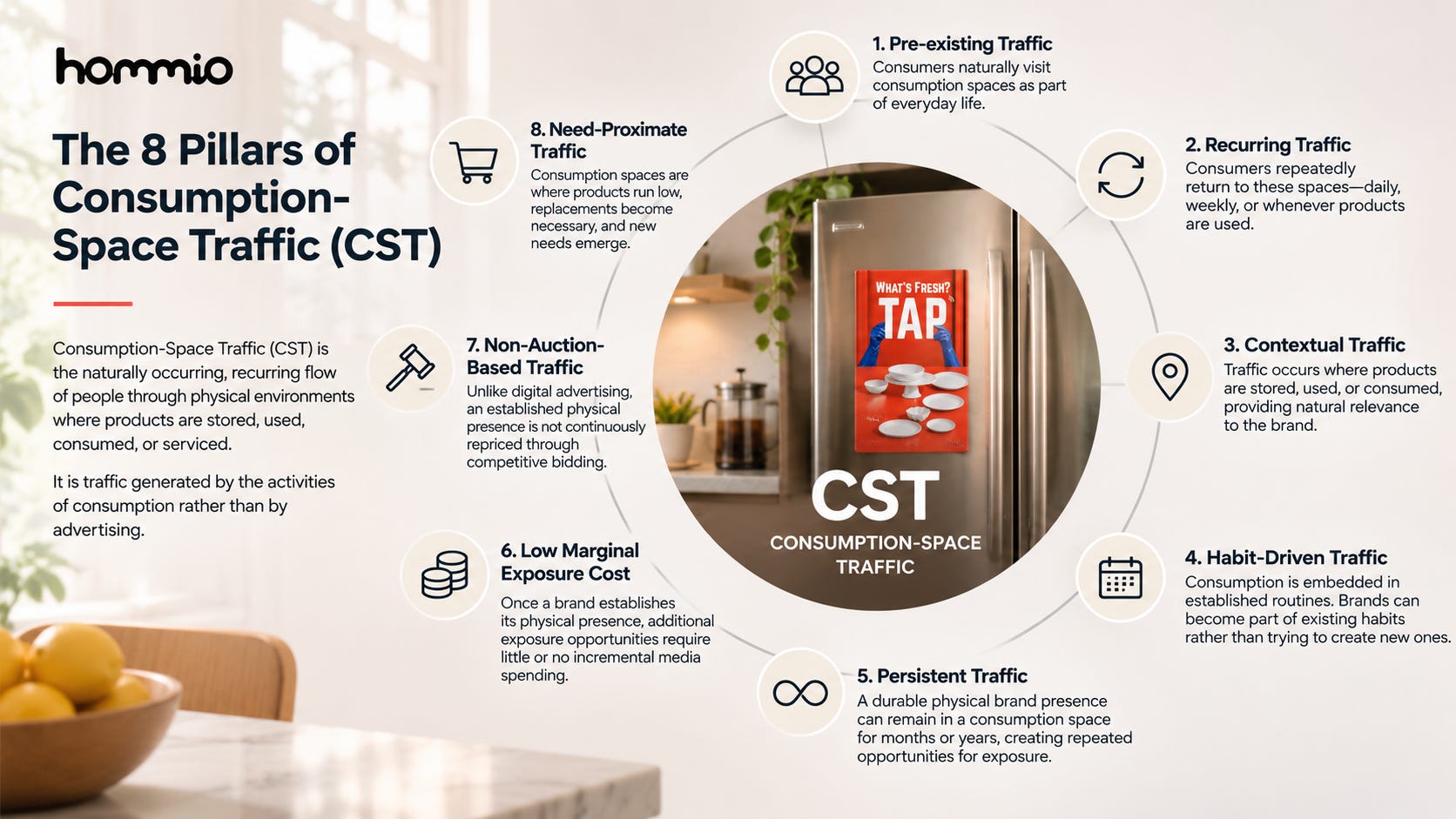
Consumption-Space Traffic is fundamentally different from traditional advertising traffic. It has eight defining characteristics:
1. Pre-existing Traffic
Consumers naturally visit consumption spaces as part of everyday life. Brands don’t need to pay to bring them there.
2. Recurring Traffic
Consumers repeatedly return to these spaces—daily, weekly, or whenever products are used. The traffic renews itself without repeated acquisition.
3. Contextual Traffic
Traffic occurs where products are stored, used, or consumed. The physical environment provides natural relevance to the brand.
4. Habit-Driven Traffic
Consumption is embedded in established routines. Brands can become part of existing habits rather than trying to create new ones.
5. Persistent Traffic
A durable physical brand presence can remain in a consumption space for months or years, creating repeated opportunities for exposure.
6. Low Marginal Exposure Cost
Once a brand establishes its physical presence, additional exposure opportunities require little or no incremental media spending.
7. Non-Auction-Based Traffic
Unlike digital advertising, an established physical presence is not continuously repriced through competitive bidding.
8. Need-Proximate Traffic
Consumption spaces are where products run low, replacements become necessary, and new needs emerge. Traffic naturally occurs close to potential repeat-purchase decisions.
The Fundamental Difference
Traditional advertising pays to bring consumers to brands. Consumption-Space Traffic allows brands to be present where consumers already go.
And because consumption naturally creates the need for replenishment, CST offers CPG brands a direct connection between everyday product use and repeat purchasing.
The Difference Between Discovery and Replenishment
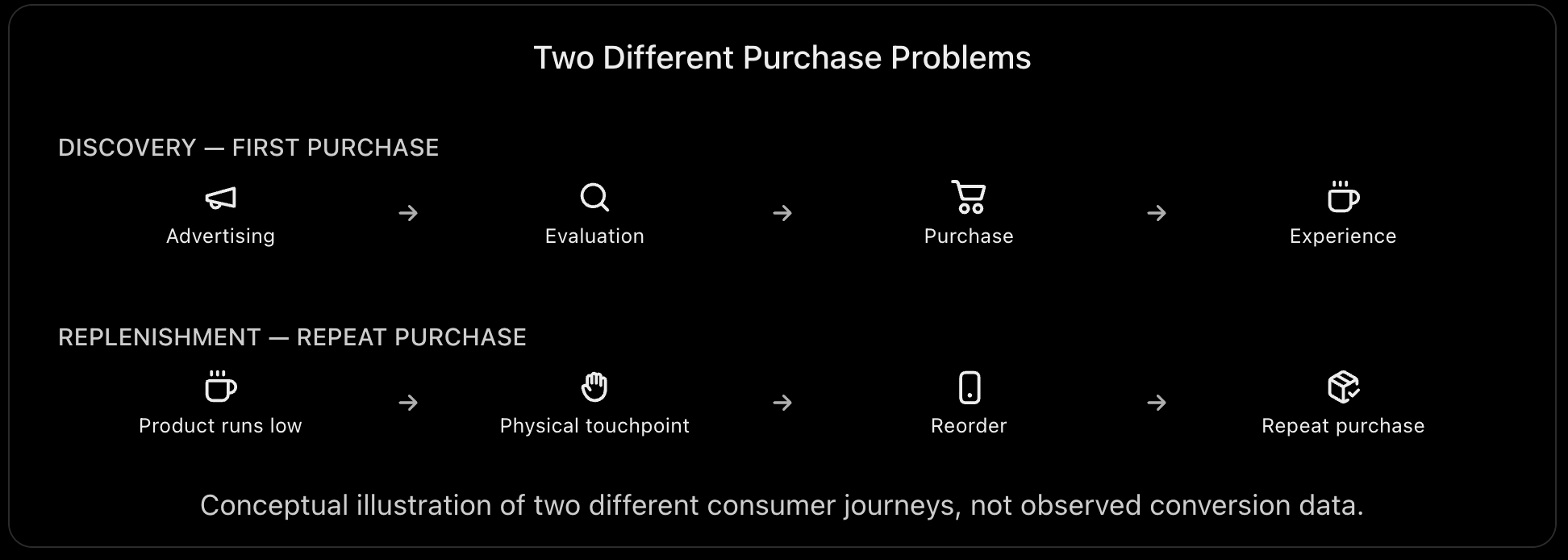
For decades, consumer brands have organized their marketing around a simple problem.
How do you get someone to buy?
You attract attention, communicate benefits, establish trust, overcome objections, and make purchasing convenient.
But the problem changes after the first purchase.
The customer already knows your brand.
They already experienced your product.
They may already trust it.
Your biggest challenge is no longer necessarily persuasion.
It is helping the customer remember, return, and reorder when the need arises.
Consider a household that buys a premium coffee brand.
The brand spends money acquiring that customer through Instagram. The customer purchases a bag and starts making coffee every morning.
For the next three weeks, the customer repeatedly experiences the product.
They open the package. They smell the coffee. They prepare it. They taste it.
That product experience is already influencing whether they want to purchase again.
Eventually, the bag becomes nearly empty.
This is the moment when the customer has a genuine replenishment need.
But what happens next?
They might open Amazon, search for coffee, and encounter dozens of competing brands.
They might receive an unrelated advertisement on Instagram.
They might forget the exact brand name.
They might buy something else at the supermarket because it is easier.
The brand created a successful product experience but failed to connect that experience with the next transaction.
The customer returned to a competitive discovery process for something they may have already decided they liked.
Now imagine something different.
A small, useful, unobtrusive physical connection remains near the coffee machine.
When the coffee runs low, the customer can use that connection to reorder the same product, choose a larger size, manage a subscription, or explore something complementary.
No fresh search is necessary.
No competing product listing needs to be examined.
The customer doesn’t have to remember which website they visited three weeks ago.
The product experience can lead directly to the next purchase.
This does not guarantee repeat purchasing. A bad product, high price, or poor service can still lose the customer.
But it removes unnecessary friction between satisfaction and action.
The best time to make repeat purchasing easier is not when someone sees your next advertisement. It is when they experience the need to buy again.
And consumption spaces are where that need often appears.
Now Look at What Is Happening to Online Traffic
The opportunity becomes even more important when you look at where digital commerce is heading.
For years, the internet has provided consumer brands with relatively accessible channels for finding customers.
You could build a Shopify website, advertise on Facebook, buy Google keywords, establish an Amazon presence, and gradually build an audience.
Those channels transformed the CPG industry.
They also created enormous dependence on third-party distribution.
Now artificial intelligence is changing the structure again.
Not simply by making advertisements easier to create, but by changing who controls product discovery and purchase decisions.
Consider what happened in November 2026.
On November 10, Anthropic filed an updated preliminary prospectus for one of the most extraordinary proposed IPOs in technology history.
The company proposed offering 825 million shares at an indicative price of $70 to $78 per share.
At the upper end, that represented approximately $64.35 billion in gross offering size, alongside a separate proposed $26 billion private placement.
Its implied valuation could reach approximately $1.4 trillion on a fully diluted basis.
Its reported annualized revenue run rate had reached approximately $81 billion by October 2026.
And its third-quarter revenue reached $17 billion, compared with approximately $1.4 billion in the same quarter the previous year.
That is more than twelvefold year-over-year growth.
The proposed IPO had not yet been completed when these figures were published.
Sources: Anthropic IPO Fact Sheet and SEC preliminary prospectus.
These numbers are not evidence that Anthropic will become a dominant consumer advertising network. Anthropic currently has a different business mix from Google or OpenAI.
But they show the extraordinary scale of capital being concentrated around AI infrastructure and interfaces.
A relatively small number of companies may become enormously influential in how people find information, evaluate alternatives, and make decisions.
That possibility should matter to you as a consumer brand founder.
Because the company that controls the starting point of a purchasing decision has an enormous influence over which brands get considered.
Now consider OpenAI.
On September 16, 2026, OpenAI introduced new advertising capabilities, including Sponsored Agents that allow consumers to choose to converse with business-sponsored assistants after clicking an ad.
It also introduced AI-assisted ad creation and campaign management through ChatGPT, alongside Shopify and HubSpot integrations.
Then, on November 10, OpenAI announced Businesses in ChatGPT.
Businesses could claim and verify their profiles, maintain product information, view aggregated discovery insights, and, for eligible businesses, publish conversational Business Agents inside ChatGPT.
OpenAI reported that ChatGPT had approximately 1.2 billion weekly users.
That is not 1.2 billion shoppers or ad impressions. It is the size of the reported weekly audience.
Sources: Reimagining Advertising with AI and Introducing Businesses in ChatGPT.
Think about what this represents.
A consumer may no longer start by searching Google for the best protein powder.
They may ask an AI assistant to compare ingredients, assess dietary preferences, explain product differences, and recommend the three most suitable choices.
Instead of browsing twenty websites, they may evaluate three options inside a single conversation.
The eventual purchase might still happen on Amazon or a brand’s Shopify store.
But the process that determined which brands deserved consideration happened somewhere else.
The brand may still own its product.
It may still own its website.
But it may not own the interface where the consumer decided what to buy.
That is a significant change.
When Intelligence Becomes Abundant, Consumer Attention Becomes More Valuable
AI is making it easier to build websites, generate advertisements, create product photography, write copy, analyze customers, and launch digital businesses.
The cost of producing marketing material is falling.
But that doesn’t mean the cost of reaching a valuable consumer will necessarily fall with it.
There is a fundamental economic distinction between producing something and distributing it.
When the cost of producing advertisements falls, more businesses can create more advertisements.
When the cost of building consumer brands falls, more businesses can compete for the same customers.
Meanwhile, consumers still have limited time, limited attention, and limited purchasing needs.
AI can multiply the amount of content competing for attention.
It cannot multiply the number of hours in a person’s day.
In fact, by reducing the amount of browsing necessary to make a decision, AI may concentrate influence into fewer moments.
This is the paradox.
It can become cheaper to make an advertisement and more valuable to control the moment when that advertisement matters.
And there is already evidence that the structure of consumer discovery is changing.
A McKinsey study published in October 2026, based on approximately 21,000 consumers across 11 countries, found that more than half of surveyed consumers had used AI for shopping-related tasks in the previous three months.
Among AI users, AI search was 3.2 times as likely to be ranked more influential than traditional search.
In the United States, the share of AI users who reported completing purchases with AI increased from roughly 10% to 17% over the previous year.
Source: McKinsey, October 28, 2026.
At the same time, the traditional web is sending fewer clicks to external destinations.
SparkToro’s analysis of Similarweb data found that approximately 68.01% of US Google searches ended without a click during the first four months of 2026.
Its earlier 2024 estimate was 60.45%, although the underlying datasets are not perfectly comparable.
A separate Pew Research Center study found that users clicked traditional search results on 8% of visits featuring Google’s AI summaries, compared with 15% of visits without those summaries.
Not every zero-click search involves AI, and these figures do not establish that ecommerce websites are losing traffic at the same rate as publishers.
But they illustrate a larger structural shift.
The consumer is increasingly able to get information and evaluate choices without visiting every intermediary website that previously participated in the journey.
Sources: SparkToro, June 2026 and Pew Research Center, July 2025.
A large amount of online activity may become concentrated within a smaller number of powerful interfaces.
And when a smaller number of interfaces control valuable access to consumer decisions, they gain greater influence over how that access is distributed and monetized.
The implications for advertising prices are not automatic.
AI can also improve targeting and conversion, lowering acquisition costs for some brands.
Adobe reported in October 2026 that AI-referred US retail visits converted 90% better and generated 83% more revenue per visit than non-AI traffic in its September data.
That is evidence of the potential value of AI-assisted shoppers, not proof of higher advertising costs.
Source: Adobe Digital Insights, October 29, 2026.
But if AI-controlled decision interfaces become scarce gateways to high-intent customers, competition for premium commercial access could intensify.
The more expensive strategic mistake may be depending entirely on those gateways.
Because every time you need to win back a customer through a third-party platform, you make yourself dependent on that platform’s economics.
Digital Advertising Is Already Expensive
You don’t have to predict the future to see the cost pressures facing consumer brands.
Triple Whale analyzed advertising data from more than 40,000 brands using its platform between August 2025 and July 2026.
Across its Meta advertising dataset, the median cost per thousand impressions increased from $13.30 to $15.06.
That is a 13.24% increase in one year.
Median cost per acquisition rose from $37.80 to $38.99.
For Food & Beverage brands, median reported cost per acquisition was $38.57.
For Beauty brands, it was $39.31.
For Pets & Animals, it was $38.51.
These are advertising acquisition benchmarks for the participating brands, not the cost of generating a repeat order from an existing customer.
The distinction matters.
But the numbers reveal the economic environment in which many consumer brands are trying to grow.
Source: Triple Whale, August 2026.
If you sell a $50 consumer product, spending nearly $39 to acquire a first customer can create a difficult financial equation.
You may justify the investment through future orders.
That is exactly why retention matters.
But there is a contradiction in the way many brands approach retention.
You acquire a customer at considerable expense because you expect that relationship to generate future purchases.
Then you continue relying heavily on the same attention platforms to bring the customer back.
You may have acquired the transaction without creating a durable path to the next one.
Email and SMS help solve part of this problem.
They are valuable and should remain part of a healthy retention strategy.
But they rely on consent, deliverability, message timing, and the consumer’s willingness to respond.
They also compete with other demands on the person’s attention.
A promotional email may arrive when the consumer has no need for the product.
A text message may arrive during dinner.
A retargeting advertisement may appear when the consumer is thinking about something entirely different.
What if you didn’t always have to predict the right moment?
What if you could make reordering available when the consumer’s own routine revealed the need?
That is what makes Consumption-Space Traffic different.
The Economics of Traffic That Already Exists

Imagine you operate a CPG brand with 10,000 customers.
You establish a small, durable, brand-relevant physical touchpoint in each customer’s consumption environment.
For this example, assume the fully deployed cost is $5 per customer, including the physical touchpoint and its allocated distribution costs.
Your initial deployment investment is $50,000.
Now suppose each touchpoint remains in place for two years.
Assume the customer passes through the relevant space five times a day.
That is:
5 potential encounters × 730 days = 3,650 potential encounters per placement.
Across 10,000 placements, that creates 36.5 million modeled opportunities for exposure.
The initial $50,000 divided by those modeled opportunities gives an effective cost of approximately $1.37 per thousand potential encounters.
Compare the scale with the $15.06 median Meta CPM reported by Triple Whale.
The difference is striking.
But these figures are not equivalent advertising measurements.
A consumer visiting a room does not prove they saw your brand.
A physical touchpoint may be removed, ignored, blocked, or forgotten.
Digital ad impressions use different measurement systems, and the physical program also carries potential technology, service, commission, and maintenance costs.
So $1.37 is not a verified advertising CPM or a demonstrated HOMMIO performance result.
It is a modeled cost per thousand opportunities for exposure.
That qualification is important.
The opportunity is not to invent a cheaper impression number.
The opportunity is to change the economics of maintaining presence.
Once a useful physical touchpoint is established, the consumer’s ordinary behavior generates repeated opportunities for the brand to be noticed or used without another advertising auction for each encounter.
A brand can invest once in establishing a durable presence and receive repeated opportunities over time.
That is a fundamentally different cost structure.
It does not mean physical traffic replaces digital advertising.
It means you no longer have to treat every future interaction with an existing customer as another media-buying problem.
And for brands selling products that are repeatedly consumed, this difference can be enormously valuable.
The Missing Infrastructure
Of course, Consumption-Space Traffic has always existed.
People have always walked into kitchens, bathrooms, workshops, and offices.
They have always returned to the places where they use products.
So why haven’t CPG brands built their retention strategies around this traffic?
Because traffic by itself is not a commercial channel.
A kitchen receives traffic.
That doesn’t mean a coffee brand can automatically measure it, interact with it, or convert it into a repeat order.
A refrigerator magnet may create brand visibility.
But brand visibility alone does not complete a purchase.
A QR code on a package may provide a digital link.
But a QR code thrown away with the empty packaging does not create lasting presence.
To turn Consumption-Space Traffic into a retention channel, you need to connect three things.
The physical environment where consumption happens.
A persistent, relevant presence that the consumer accepts.
And a simple path from consumer need to useful brand action.
The first already exists.
The second must be earned.
The third must be built.
The result is not another advertising impression.
It is a continuing connection between the product experience and the next meaningful interaction.
That interaction might be a reorder.
It might be a subscription adjustment.
It might be product guidance, a compatible accessory, a relevant reward, or a question the customer voluntarily chooses to answer.
The objective isn’t to force consumers to engage.
It is to make a useful interaction available when they want one.
That distinction matters because a peaceful relationship is not a less effective relationship.
Often, the opposite is true.
You don’t need to interrupt someone every week to remain useful.
You need to be there when they need you.
The Sale Should Create a Channel
There is an assumption embedded in traditional marketing that deserves to be challenged.
Channels create sales.
You invest in search, social, retail, marketplaces, and other distribution channels.
Those channels bring consumers to your product.
You make a sale.
Then you repeat the process.
But what if the relationship worked in both directions?
Every sale could create a channel.
Not a new advertising network.
A durable, customer-permitted connection established through the product’s presence in everyday life.
When someone buys your coffee, the sale can create an opportunity for continued presence near the coffee machine.
When someone buys pet food, the sale can create an opportunity for useful connection in the feeding area.
When someone buys a cleaning product, it can establish a touchpoint near the place where cleaning happens.
Not every product or environment will be equally suitable.
But across much of CPG, physical consumption is repetitive, contextual, and closely connected to future purchasing needs.
That creates an enormous opportunity to move beyond the transaction.
Your relationship with a customer should not disappear between orders.
It should become easier, quieter, and more useful.
In nature, a perennial plant does not begin from a new seed every morning.
It establishes roots in a place where the conditions allow it to continue growing.
Consumer brands have become extraordinarily sophisticated at acquiring the next seed.
They have invested far less effort in establishing a persistent presence where their existing customers already live and consume.
The most valuable shift may not be acquiring attention more aggressively.
It may be earning a place in the environment where the relationship can continue.
This Is Why We’re Building HOMMIO
HOMMIO is built around a simple conviction.
Retention is at home.
More broadly, the underlying opportunity is Consumption-Space Traffic.
The idea is to help CPG brands establish a durable, useful connection inside the environments where their products are consumed.
For HOMMIO’s initial application, that environment is the home.
A brand can introduce a small physical Reorder Magnet through a product delivery or another appropriate customer touchpoint.
The consumer chooses whether to keep and use it.
It can sit near the refrigerator, coffee machine, range hood, or another relevant location.
It doesn’t need to demand attention.
It doesn’t need to push notifications.
It remains available.
When the customer wants something, a simple tap can create a direct path to a brand-defined experience.
For one consumer, that may mean reordering the same product.
For another, it may mean exploring a larger pack.
For a subscriber, it may mean managing a delivery.
For someone with a product question, it may mean getting help.
The brand defines the relevant goals, offers, eligibility, and commercial rules.
The consumer initiates the interaction.
AI can help determine which appropriate action to offer based on the available context and the permissions provided.
The goal is not to assume who the person is, collect information without consent, or turn the kitchen into another advertising feed.
The goal is to reduce friction when an existing consumer wants to interact with a brand.
This can support both DTC and marketplace businesses.
For a DTC brand, the experience can lead toward the brand’s own commerce and subscription systems.
For an Amazon-focused brand, it can lead back toward an appropriate Amazon purchase destination.
The exact economics and policy requirements differ.
But the underlying idea remains the same.
A transaction that previously ended when the product was delivered can also become the beginning of a lasting physical connection.
That is how a brand can begin turning Consumption-Space Traffic into a channel for retention.
The Next Great CPG Opportunity May Already Be Inside Your Customer’s Life
You should still advertise.
You should still invest in Google, Meta, Amazon, creators, retail distribution, email, and SMS where they work.
Consumption-Space Traffic is not an argument against online traffic.
It’s an argument against ignoring a completely different category of traffic that already exists around your products.
The internet will continue evolving.
AI may make advertising more intelligent and efficient.
It may also concentrate the power to influence purchasing decisions among fewer platforms.
New competitors will enter your category.
Existing marketplaces will continue presenting alternatives.
The cost of acquiring a customer will fluctuate with technology, competition, and consumer behavior.
You cannot control all of that.
But you can make a different decision about what happens after the customer buys.
You can treat the sale as the end of an acquisition funnel.
Or you can treat it as the beginning of an enduring relationship.
You can continue fighting for another brief moment of attention.
Or you can build a useful presence that remains available through everyday consumption.
This is why I believe Consumption-Space Traffic represents the single most overlooked retention opportunity for CPG brands.
It applies to a fundamental reality shared by the industry: products are bought so they can be used, and many products are used in recurring physical environments.
For some categories, the value comes from frequent replenishment.
For others, from maintenance, subscription management, replacement, accessories, or product support.
The commercial opportunity will vary, but the underlying traffic is already there.
And unlike a digital advertising platform, everyday life does not charge brands an auction price every time a customer walks into the kitchen.
The challenge is earning permission to participate in that life in a useful way.
That is the opportunity HOMMIO is pursuing.
Not to create more noise.
Not to make consumers interact with another platform.
But to help brands transform the traffic generated by everyday consumption into lasting customer relationships.
The most valuable traffic in CPG may be the traffic your customers are already generating.
You just haven’t built a channel for it yet.
Billy HAO.